VED AI
A writer first next-gen writing tool
Feb 2026 - Jun 2026
AI
B2C
WRITERS
SaaS
How might we help writers overcome blank-page anxiety and confidently begin writing within seconds of entering a project?
THE PROBLEM
Responsible for product discovery, user research, Interaction design, IA, Prototyping and validation and Usability testing.
MY ROLE
MY TEAM

Srikanth
Head of Product

Aakash (Me)
Lead designer

Bharat
Product Manager

Shubham
Developer
38%
Reduction in time-to-first-word
52%
Users started writing within 2 minutes
72%
Brainstorm to story conversion (North Star Metric)
84%
Reported feeling more confident when starting a new document
Let's
start
with
our
design
process
:)
STEP 1


Issue 1: The Empty Canvas Dominates Everything
Nearly 70% of the screen is occupied by an empty input field.
Visually this communicates "Start Writing" but the user is not yet prepared to write.
This causes anxiety because the system demands output before providing a clear structure.
Research consistently shows that users are more likely to engage when given: prompts, templates, guided worlflows etc. The current UI offers none of that.
Issue 2: No Clear First Action
User lands here and sees multiple possible actions. They can go to the left bar, brainstorm session, centre canvas, genre section etc…
No visual hierarchy indicating "Do this first"
A new user should never need to decide where to begin.
Yet here they must.
Issue 3: Brainstorm Feature Is Hidden in Plain Sight
The main USP of the app is treated as a secondary feature.
Many users interpreted it as: Help desk, promotional widget, and AI Assistant chat.
This in turn creates a discoverability issue. As this is the ideal starting point for story creation.
Issue 4: Users Don't Understand the Workflow
The screen does not answer: "What happens after I write something?"
A writer's mental model is: Idea → Plot → Characters → Chapters → Draft
The interface exposes tools but not the journey.

STEP 2
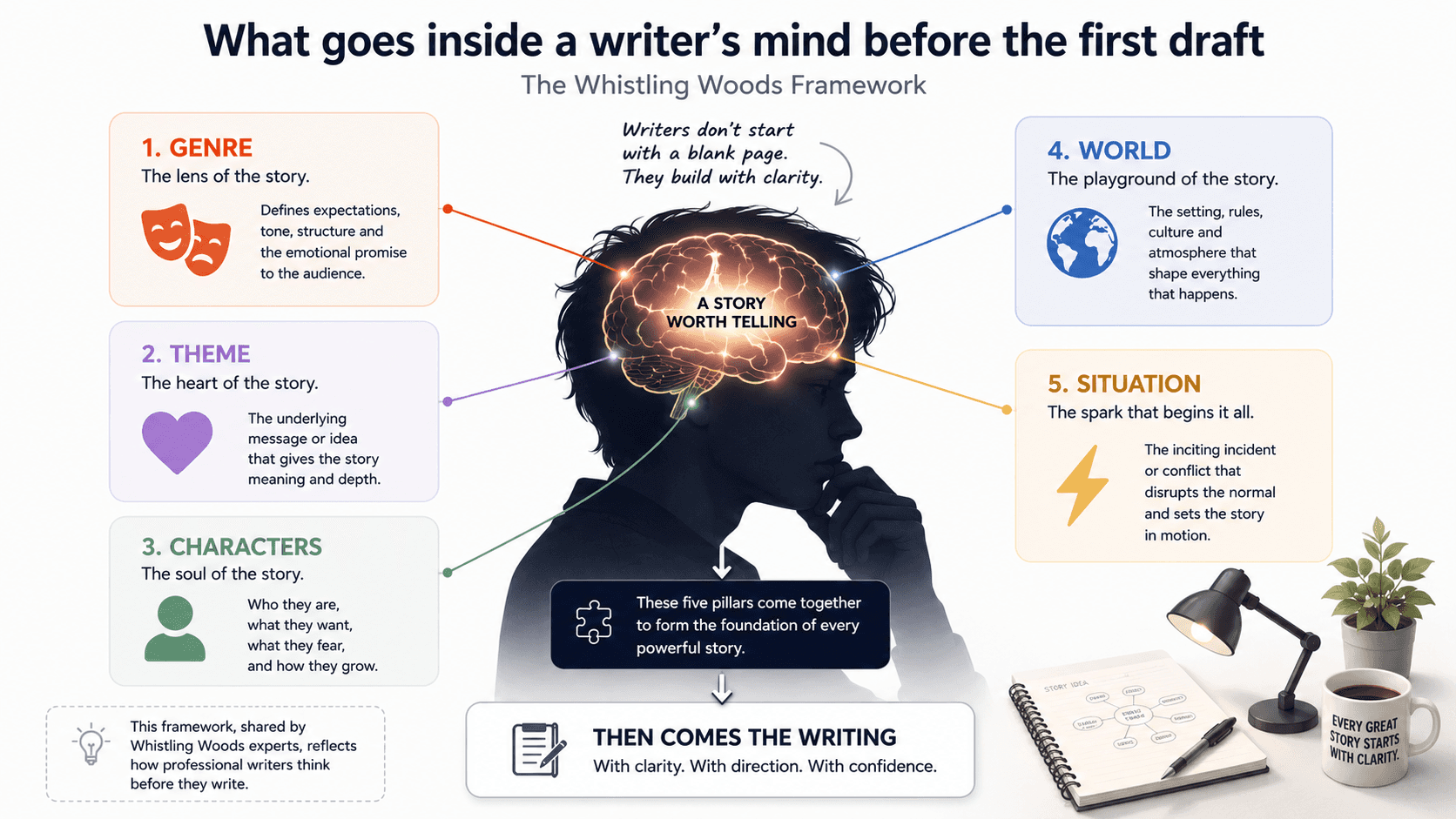
As part of our research, we partnered with experts from Whistling Woods International (WWI). They helped us understand that writers don't start with a blank page—they build stories around five pillars: Genre, Theme, Characters, World, and Situation. This insight shaped our redesign, transforming Ved from an empty editor into a guided storytelling experience.
STEP 3
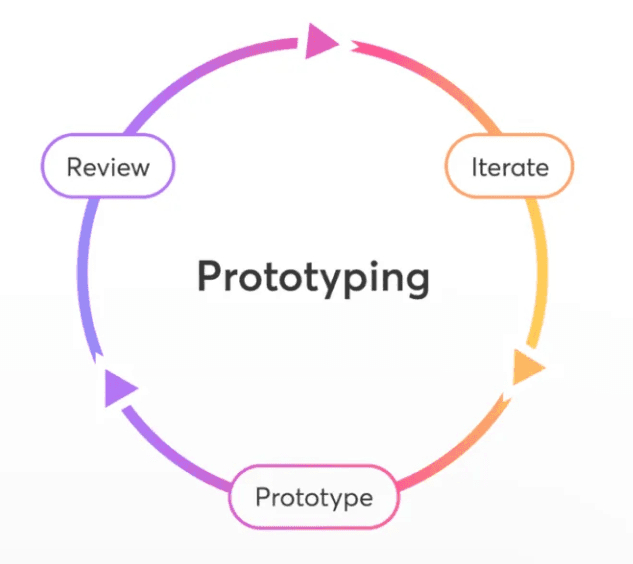
Since prototyping has become significantly easier with the onset of AI. We could very easily validate our idea and make rapid changes to it.
Iteration 1
For the initial hypothesis we quickly made a prototype on figjam which enabled us to test whether our approach is in the right direction or not.
What worked
Guided conversation instead of an empty page
Users answer one question at a time.
Reduces cognitive load and decision paralysis.
Feels more like talking to a writing coach than using a document editor.
Progressive story building
The system helps establish key story pillars (character, world, premise, etc.).
Users can focus on one decision instead of inventing an entire story at once.
Visualization of ideas
Generated cards and nodes make progress visible.
Creates a sense of momentum and accomplishment.
Lower activation energy
Starting with a simple answer is much easier than writing the first paragraph of a story.
What needs improvement
Still feels like a questionnaire at times
Users feel they are filling out a form rather than creating a story.
Several consecutive questions can become repetitive.
Lack of creative ownership
The AI drives most of the process.
Some writers may feel the story is being generated for them instead of with them.
Linear exploration
Writers often think non-linearly.
The flow encourages a fixed sequence, which may feel restrictive for experienced writers.
No clear overview of progress
Users don't always know how many steps remain or how close they are to a complete concept.
Went
through
a
couple
of
more
iterations
until
we
landed
on
our
final
design
STEP 4
Made the final design for our MVP with claude code. Made sure to keep it as close to the real experience we want to give to our user and get feedback from them. We even pitched it to one of our investors and received amazing feedback from him.
What worked
The user sees progress taking shape
Unlike the previous version where users were answering questions in isolation, this flow visualizes the story structure as it emerges.
Impact: Reduces anxiety because users can see what they've already accomplished.
Better balance between guidance and creativity
This version feels more collaborative:
AI asks questions.
Users make choices.
Story elements appear visually.
Impact: Users retain more ownership of the story.
Stronger mental model
The flow now mirrors how writers think:
Story type
Core idea
Characters
World
Plot
Draft
Visible transition from ideation → writing
This version clearly transitions into:
Outline
Story beats
Generated draft
Screenplay
What needs improvement
The story map becomes visually dense
Once multiple nodes appear, the canvas starts looking like a flowchart tool.
For experienced writers this is useful.
For new writers it may feel overwhelming.
Need to make sure that the user understand that source of truth changes as the user progresses.
The system works in a back track manner. For story the source of truth is brainstorming
For beatsheet the source becomes the story.
For script the source becomes the beats.
Need to give collaboration support options down the line
Writing is often considered a group activity, with studios being one of our core segments, we need to incorporate better collaboration features in order to drive funds towards the business.

Ending note
Thank you for reading it till the end. This was just one of the many problems that I solved. There might be a more optimized solution other than the ones that I highlighted here. I am open to feedbacks, if you have a better solution.


Intrigued by my approach to product design? Let’s start a conversation!